Leonid Meteor Shower - 2009

Away from city lights from 10th November, 2009 to 21st November, 2009 people can witness celestial spectacle of Leoinid Meteor Shower from pollution free dark skies few hours before sun rise towards East.

Schools can mail us at planetarysocietyindia dot gmail dot com for school kit and information about sky observation in Hyderabad/Vijaywada.

Leonid Meteor Shower: A meteor is a shooting star (layman’s Language), space dust about the size of a grain of sand. The dust hits the earth’s atmosphere and burns up in a blaze of light.

Where does space dust come from? Comets and asteroids pass through our solar system. These objects leave dust behind them. When earth crosses through these dust clouds we see a meteor shower.
In case o a meteors originating from comets When a comet flies close to the sun, intense heat vaporizes the comet’s "dirty ice" resulting in high-speed jets of comet dust that spew into interplanetary space. When a speck of this comet dust hits Earth's atmosphere traveling at greater speed, it disintegrates in a bright flash of light—a meteor!

Comet 55P/Tempel-Tuttle – The source/Parent body of Material for this shower: comet Tempel-Tuttle is source body which during its passage intersects earth orbit giving out the material which is responsible for this meteor shower. Trails laid down by the comet passage in 1466 and 1533 are expected to be the chief contributors to whatever happens this year. The most recent perihelion passage of the Leonids' parent comet, 55P/Tempel-Tuttle happened in 1998. Though more than a decade ago now, the shower's activity has continued to be fascinatingly variable from year to year.

Name – Leonid – Constellation of Leo : This Meteor shower is called “Leonid Meteor shower” because location of shower radiant in the constellation Leo i.e the meteors or streaks of light appear to stream from, in the background of leo constellation in sky.


As per the report of International Meteor Organization (IMO) on 17th Nov, 09 at 8.40 p.m Meteor shower will be at peak where more than 100 meteors per hour are expected to be seen from dark skies. Various Forecasts (including NASA) of the peak range from 100 to 500 meteors per hour—rating it somewhere between a "good show" and a "half storm." Observers in Asia are favored to see the brief but intense display. Thus making it a interesting event of the year to observe particularly in India where the conditions have been predicted to be better during the peak.

Where to Look and Best Time : the best time for observing this spectacle from India is after 3 a.m. on 18th Nov,09 when the constellation of Leo is sufficiently above in eastern horizon. One has to look towards direction between North East and East Direction.

Society suggests observation from pollution free dark clear skies away from city lights with good horizon for splendid experience.

The Unsung Hero - Moon Impact Probe (Chandrayaan I) - First Anniversary of Moon Impact

Moon Impact Probe

The Moon Impact Probe (MIP) developed by the Indian Space Research Organisation (ISRO), India's national space agency, was a lunar probe that was released by ISRO's Chandrayaan-1 lunar remote sensing orbiter which in turn was launched, on 22 October, 2008, aboard a modified version of ISRO's Polar Satellite Launch Vehicle.

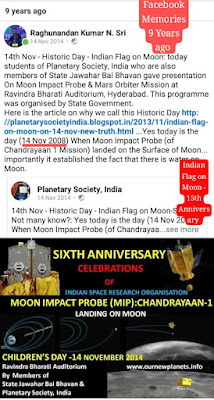
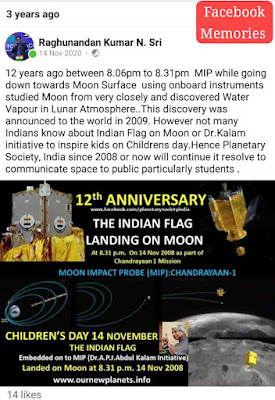
The Moon Impact Probe separated from the moon-orbiting Chandrayaan-1 on 14 November 2008, 20:06 and crashed, as planned, into the lunar south pole after a controlled descent.

The MIP struck the Shackleton Crater at 20:31 on 14 November 2008 releasing underground debris that could be analysed by the orbiter for presence of water ice.[1] With this mission, India became the fifth entity to reach the lunar surface. Other entities to have done so are the former Soviet Union, the United States, the European Space Agency (currently owned by 18 member nations) and Japan.[2]


Kalam's Vision
The probe was a product of former President Abdul Kalam's vision who felt that since the Chandrayaan orbiter was already going so near to the moon, the mission would have more scientific relevance if the probe was included. He believed that the moon could not be left to a few countries and that India should not be left behind. He suggested the probe to ISRO where it was supported enthusiastically.[2]

The inclusion of a flag on the probe led to confused media disccussion about India planting its flag. The Times of India also reported a political motive by former president Abdul Kalam as "He believed that if this was done, India could always stake a claim to a portion of the Moon."[2] At the same time, The Indian Express reported Kalam as saying "no nation can claim the moon as its own. The resources of the moon should be a common property and that is one of the aims of the moon mission."[4]

Mission objectives
The main objectives of the MIP were to demonstrate the technologies for reaching a specified location on the Moon, qualifying technologies required for any future soft landing missions, and scientific exploration of the moon from close range just prior to the impact.

The probe was designed to collide with the lunar surface and eject underground soil which could then be analysed by instruments on the orbiting Chandrayaan for the presence of water ice, and organic and other materials.

Payload
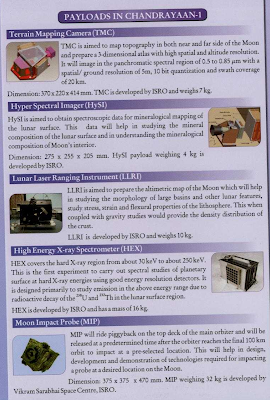
The MIP carried three instruments:

Radar Altimeter – which measured the altitude of the probe during descent and provided information on qualifying technologies for future landing missions. The operating frequency band was 4.3 GHz ± 100 MHz.
Video Imaging System – acquired close range images of the surface of the Moon during descent and before impact. The video imaging system consisted of an analog CCD camera.

Mass Spectrometer based payload CHACE – measured trace constituents of the lunar atmosphere during descent. This instrument was a quadrupole mass spectrometer with a mass resolution of 0.5 amu and sensitivities to partial pressures on the order of 1.3×10⁻¹¹ pascals.

The probes external surface had four oval shaped anodised aluminium plates measuring 120mm X 180 mm[10] on which the image of the Indian flag was depicted, complete with the Emblem of India and the words "Satyameva Jayate".[10] These plates were attached to each one of the four vertical sides of the probe. As per ISRO specifications these plates had to endure a temperature range from -50 degrees celsius and as high as +150 degrees celsius.

Mission chronology
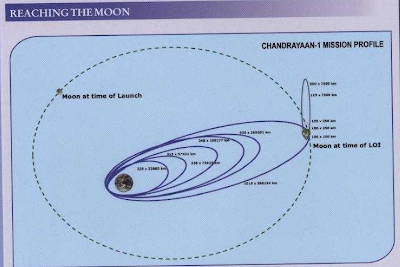
India launched the Chandrayaan-1 spacecraft using a modified version of the PSLV C11[11][12] on 22 October 2008 from Satish Dhawan Space Centre, Sriharikota, Andhra Pradesh at 06:22 IST (00:52 UTC).

The lunar probe separated from Chandrayaan-1, in a 102 km circular polar orbit around the Moon, at 20:06 IST on 14 November 2008.[1] After separation, it first fired its spin up rockets and then its retro rocket to lower itself to an orbit intersecting the lunar surface.[14][15] While descending, the MIP continuously sent information back to the Chandrayaan-1 orbiter which in turn beamed the information back to earth. After a 25 minute controlled descent, it struck the Moon at 20:31 IST, 14 November 2008 at a speed of 1.69 kilometers per second (approximately 6100 km/h or 3800 miles per hour).[15] The crash destroyed the probe.[14] It crashed into Shackleton Crater, at the lunar south pole, at 20:31 on 14 November 2008 releasing underground material that could be analyzed by the orbiter for the presence of water ice.

Discovery of water
On the 25 September, 2009, ISRO announced that the MIP had discovered water on the moon just before impact. This announcement was made after the discovery of water was announced on September 24, 2009 by Science magazine by the NASA payload Moon Mineralogy Mapper carried on board Chandrayaan-1.

It gifted the answer to the millennia-old question whether water is there in Earth’s moon when it led to the discovery of water in its vapour phase by the CHACE (CHandra’s Altitudinal Composition Explorer) payload onboard the Moon Impact Probe (MIP) and complementarily in its solid phase by the Moon Mineralogy Mapper (M3) payload onboard the main orbiter in the Chandrayaan I mission. This ‘discovery-class-of-finding’ by CHACE was achieved by direct in situ measurement of the lunar atmosphere during the descend journey of the MIP to the Lunar South Pole, while M3 discovered water in ice form by remote sensing techniques. As water cannot retain its liquid phase in the lunar environment because of its own vapour pressure and the ultra-high vacuum prevailing there, it can be found in solid (ice) and gaseous (vapour) phases. While the Moon Mineralogy Mapper (M3), a payload by NASA, onboard Chandrayaan I lunar orbiter has detected, by mapping almost 97 % of the lunar surface using remote sensing techniques, the presence of water in ice form in higher latitudes especially in the polar caps, the CHACE payload in the lunar impactor (MIP) has directly detected water in its gaseous form along 14 degree E meridian from 45 degree N to 90 degree S latitude, with a latitudinal resolution of around 0.10 and altitudinal resolution of ~ 250 m from 98 km altitude till impact .

However on the day of First anniversary we

World will not end in 2012 - NASA

Dear freinds there is lot to talk to tackle this tsunami of 2012 questions. Here is some of the questions and answers provdied by NASA. Later we will write in detail.

Question (Q): Are there any threats to the Earth in 2012? Many Internet websites say the world will end in December 2012.
Answer (A): Nothing bad will happen to the Earth in 2012. Our planet has been getting along just fine for more than 4 billion years, and credible scientists worldwide know of no threat associated with 2012.

Q: What is the origin of the prediction that the world will end in 2012?
A: The story started with claims that Nibiru, a supposed planet discovered by the Sumerians, is headed toward Earth. This catastrophe was initially predicted for May 2003, but when nothing happened the doomsday date was moved forward to December 2012. Then these two fables were linked to the end of one of the cycles in the ancient Mayan calendar at the winter solstice in 2012 -- hence the predicted doomsday date of December 21, 2012.

Q: Does the Mayan calendar end in December 2012?
A: Just as the calendar you have on your kitchen wall does not cease to exist after December 31, the Mayan calendar does not cease to exist on December 21, 2012. This date is the end of the Mayan long-count period but then -- just as your calendar begins again on January 1 -- another long-count period begins for the Mayan calendar.

Q: Could a phenomena occur where planets align in a way that impacts Earth?
A: There are no planetary alignments in the next few decades, Earth will not cross the galactic plane in 2012, and even if these alignments were to occur, their effects on the Earth would be negligible. Each December the Earth and sun align with the approximate center of the Milky Way Galaxy but that is an annual event of no consequence.

"There apparently is a great deal of interest in celestial bodies, and their locations and trajectories at the end of the calendar year 2012. Now, I for one love a good book or movie as much as the next guy. But the stuff flying around through cyberspace, TV and the movies is not based on science. There is even a fake NASA news release out there..."

- Don Yeomans, NASA senior research scientist Q: Is there a planet or brown dwarf called Nibiru or Planet X or Eris that is approaching the Earth and threatening our planet with widespread destruction?
A: Nibiru and other stories about wayward planets are an Internet hoax. There is no factual basis for these claims. If Nibiru or Planet X were real and headed for an encounter with the Earth in 2012, astronomers would have been tracking it for at least the past decade, and it would be visible by now to the naked eye. Obviously, it does not exist. Eris is real, but it is a dwarf planet similar to Pluto that will remain in the outer solar system; the closest it can come to Earth is about 4 billion miles.

Q: What is the polar shift theory? Is it true that the earth’s crust does a 180-degree rotation around the core in a matter of days if not hours?
A: A reversal in the rotation of Earth is impossible. There are slow movements of the continents (for example Antarctica was near the equator hundreds of millions of years ago), but that is irrelevant to claims of reversal of the rotational poles. However, many of the disaster websites pull a bait-and-shift to fool people. They claim a relationship between the rotation and the magnetic polarity of Earth, which does change irregularly, with a magnetic reversal taking place every 400,000 years on average. As far as we know, such a magnetic reversal doesn’t cause any harm to life on Earth. A magnetic reversal is very unlikely to happen in the next few millennia, anyway.

The Blue Marble: Next GenerationEarth, as seen in the Blue Marble: Next Generation collection of images, showing the color of the planet's surface in high resolution. This image shows South America from September 2004. Q: Is the Earth in danger of being hit by a meteor in 2012?
A: The Earth has always been subject to impacts by comets and asteroids, although big hits are very rare. The last big impact was 65 million years ago, and that led to the extinction of the dinosaurs. Today NASA astronomers are carrying out a survey called the Spaceguard Survey to find any large near-Earth asteroids long before they hit. We have already determined that there are no threatening asteroids as large as the one that killed the dinosaurs. All this work is done openly with the discoveries posted every day on the NASA NEO Program Office website, so you can see for yourself that nothing is predicted to hit in 2012.

Q: How do NASA scientists feel about claims of pending doomsday?
A: For any claims of disaster or dramatic changes in 2012, where is the science? Where is the evidence? There is none, and for all the fictional assertions, whether they are made in books, movies, documentaries or over the Internet, we cannot change that simple fact. There is no credible evidence for any of the assertions made in support of unusual events taking place in December 2012.

Q: Is there a danger from giant solar storms predicted for 2012?
A: Solar activity has a regular cycle, with peaks approximately every 11 years. Near these activity peaks, solar flares can cause some interruption of satellite communications, although engineers are learning how to build electronics that are protected against most solar storms. But there is no special risk associated with 2012. The next solar maximum will occur in the 2012-2014 time frame and is predicted to be an average solar cycle, no different than previous cycles throughout history.